The idea of free and open sharing in education is not new. In fact, sharing is probably the most basic characteristic of education: education is sharing knowledge, insights and information with others, upon which new knowledge, skills, ideas and understanding can be built.–Open Education Week
Open pedagogy uses OER as a jumping-off point for remaking our courses so that they become not just repositories for content, but platforms for learning, collaboration, and engagement with the world outside the classroom. –Robin DeRosa and Scott Robison, “Pedagogy, Technology, and the Example of Open Educational Resources”
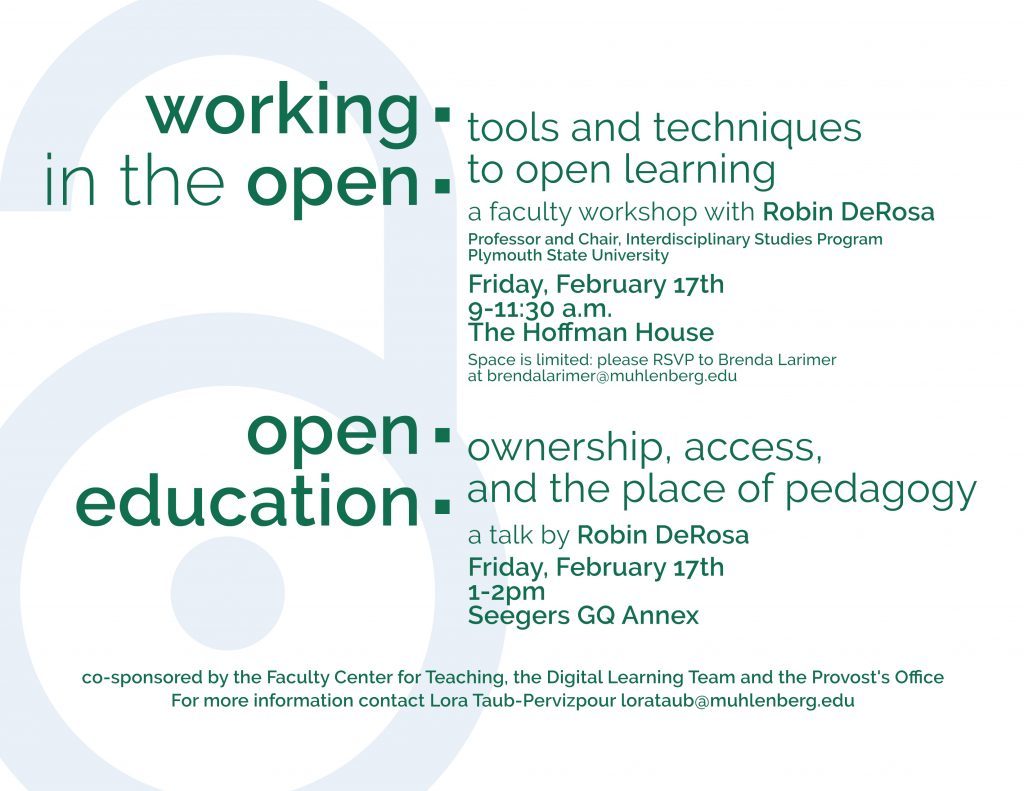
On February 17, 2017, the Digital Learning Team and the Faculty Center for Teaching are co-sponsoring two events exploring the topic of open education with Robin DeRosa from Plymouth State University. Robin is a professor and the director of the Interdisciplinary Studies Program at Plymouth State, where she also contributes widely to conversations about the future of higher education, and the ways that collaborating around open education can help make academic scholarship more relevant and accessible to the public. The resources gathered here will help orient interested faculty and staff to the topics we will be exploring during Robin’s workshop and lecture on Friday. For those who were unable to attend last month’s Tech Tuesday, Jen Jarson and Lora Taub facilitated A Conversation on Open Education, and the video recording of that session is available here.
Readings
- Robin DeRosa, “My Open Textbook: Pedagogy and Practice.”
- Steve Greenlaw, Open Educational Resources (OER): One Path to Making Higher Ed More Affordable
- David Wiley, “What is Open Pedagogy?”
- Linda Vanuspa, Amy Wiley, Lizabeth Schlemer, Dana Ospina, Peter Schwartz, Deborah Wilhelm, Catherine Waitinas and Kelly Hall, What Does It Mean to Open Education? Perspectives on Using Open Educational Resources at a US Public University
- Patrick Blessinger and TJ Bliss, Introduction to Open Education: Towards a Human Rights Theory
The reading by Robin, “My Open Textbook: Pedagogy and Practice,” offers a detailed narrative of her engagement with open pedagogy over many semesters, and a look at how her practices and beliefs about teaching and learning in the open and online have continued to develop. Towards the end of the article, she raises several critical questions about the “pitfalls, barriers, and challenges” she’s still wrestling with. These questions provide some rich ground for our conversation with Robin while she’s at Muhlenberg. Because she shares her journey into open education, Robin’s account is particularly instructive for those of us just beginning to think about this.
Steve Greenlaw is a Professor in the University of Mary Washington Economics Department and describes in this short article his interest in OERs as an alternative to the expensive commercial introductory textbooks in his field. In Open Educational Resources (OER): One Path to Making Higher Ed More Affordable, Greenlaw writes:
Estimates of annual textbook costs range from $500 to more than $1000 per student. Note the disconnect between the price per book and the spending per student. How can we reconcile these two points? One way is understand that 50% of college students report going without the text required for a course. Another way is to recognize that increasingly students spend their textbook dollars on used books or rentals, which while cheaper than new books are still pricey.
For many faculty, the pressing issue of access and expense drives their turn to OERs. In this regard, there is a social justice dimension to the open education movement that merits our discussion.
But there is more to open pedagogy than just replacing expensive commercial texts, says David Wiley in “What is Open Pedagogy?” Wiley is Chief Academic Officer of Lumen Learning, “an organization dedicated to increasing student success, reinvigorating pedagogy, and improving the affordability of education through the adoption of open educational resources by schools, community and state colleges, and universities.” You can read more about him here. In particular, Wiley is interested in the potential of open pedagogy to “kill the disposable assignment.” What is a disposable assignment?
“[A]ssignments that students complain about doing and faculty complain about grading. They’re assignments that add no value to the world – after a student spends three hours creating it, a teacher spends 30 minutes grading it, and then the student throws it away. Not only do these assignments add no value to the world, they actually suck value out of the world.”
In Wiley’s terms, instances of open pedagogy are assignments that engage with OERs. Indeed, for Wiley, the ultimate test of whether an assignment is open is that “the assignment is impossible without the permissions granted by open licenses.” How are the kinds of assignments he’s iterating similar to those that Robin DeRosa is describing in her work?
The last reading included here describes the work of a learning community at Cal Poly San Luis Obispo, where a group of faculty and librarians explored OER integration. In What Does It Mean to Open Education? Perspectives on Using Open Educational Resources at a US Public University, the authors consider the variety of reasons participants came to consider OERs, and the questions and discussions that emerged for them along the way.
“[W]e realized that in asking a relatively straightforward question about using different learning materials — “What does it mean to use Open Educational Resources?” — we were, in fact, looking at the foundations of higher education itself. We were not just asking about credible educational resources; we were asking, “What does it mean to open education?” In so doing, we also began to question how much the systems of higher education are themselves closed and self-replicating. We questioned how these systems prioritize conserving the educational institution itself over actual mastery of content and developing intellectual habits of mind. Through our discussions, “opening education” grew to mean encouraging a revival within our students and ourselves of the essence of scholarship: to experiment and discover rather than to assert and repeat, and to engage in a practice of openness as part of a community of teacher-learners — both inside and outside of the classroom.
What can we learn from the discussions and processes presented in this article? What would a learning community to support exploration and integration of OERs in teaching and learning at Muhlenberg look like? How would this intersect with the Domain of One’s Own initiative, and other pedagogical initiatives aimed at creating more open, more inclusive and accessible learning experiences in the liberal arts at Muhlenberg?
Please join us on Friday, February 17, as we begin exploring these questions with Robin DeRosa.